Charlie Bucket
Charlie and the Chocolate FactoryCharlie Bucket is the hero of the story and the small boy born into the severely poor Bucket household. His decisive significance lies in the contrast between his lack of money and the abundance promised by Willy Wonka's world: although Charlie appears to have almost no chance of entering the competition, he becomes the finder of the last Golden Ticket and is eventually offered the entire Wonka's Chocolate Factory.
Identity and Background
Charlie is the son of Mr Bucket and Mrs Bucket. He lives with them and four elderly grandparents in a house so cramped that Mr and Mrs Bucket and Charlie sleep on mattresses on the floor. The family cannot afford either a better house or even another bed. Mr Bucket is the only family member with a job, working at a toothpaste factory as a cap-screwer, a poorly paid task that leaves the household without enough money for proper food.
The family's meals express Charlie's circumstances with unusual bluntness: bread and margarine for breakfast, boiled potatoes and cabbage for lunch, and cabbage soup for supper. Sundays bring the small luxury of a second helping, but the whole family still moves through each day with an empty feeling in their stomachs. Charlie's poverty is therefore not an incidental background detail; it shapes his access to chocolate, his expectations, and the emotional force of every sweet he receives.
The Golden Ticket and Its Discovery
Willy Wonka's announcement offers five children a personal tour of his factory, access to its secrets and magic, and enough chocolates and sweets to last them for the rest of their lives. The tickets are hidden beneath the ordinary wrappers of five ordinary chocolate bars, and the bars may be anywhere in the world. The announcement turns chocolate into a global object of pursuit, producing frantic buying, smashed piggy banks, criminal extravagance, counterfeit claims, and even an unsuccessful machine designed to detect gold through a wrapper.
Charlie initially understands that the contest is almost impossible for him. He normally receives only one bar of chocolate a year, and Grandpa George observes that the children most likely to find the tickets are those who can afford to buy bars every day. The worldwide buying spree makes the economic imbalance visible: other searchers can convert money into repeated chances, while Charlie can barely obtain a single opportunity.
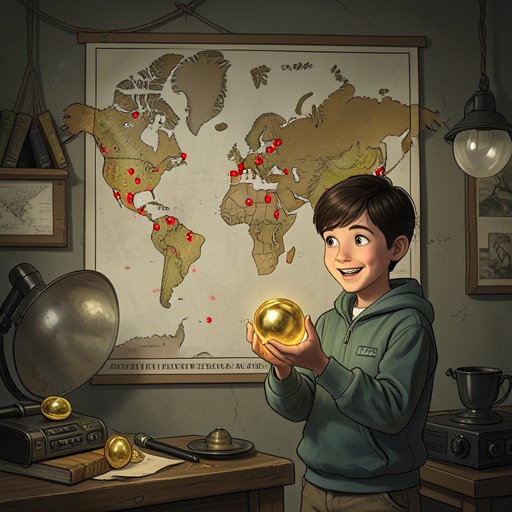
On the day before his birthday, Charlie nevertheless obtains another chocolate bar. After considering the possibility quietly, he asks for one more bar of the same kind, a Whipple-Scrumptious Fudgemallow Delight. When he tears off the wrapper, a brilliant flash of gold appears beneath it. The shopkeeper recognizes it as the last Golden Ticket and announces that Charlie has found Wonka's final ticket.
The discovery reverses Charlie's position without erasing the poverty that preceded it. He does not win through purchasing power or an organized campaign. His entry into the competition comes through an extraordinary accident of timing and chance, making the ticket a sudden opening in the economic wall that had seemed to exclude him.
Public Attention and the Factory
The discovery immediately makes Charlie a public spectacle. News of the fifth finder reaches the newspapers, and swarms of newspapermen and photographers track him down at home. They pour into the small house seeking the story for the morning papers, creating several hours of complete pandemonium before Mr Bucket finally gets them to leave near midnight. Charlie's private triumph is thus transformed into a public event, with the media treating his poverty-stricken home as the scene of a global sensation.
At the factory, Charlie encounters a world whose scale and labor extend far beyond the household that produced him. Willy Wonka explains that the Oompa-Loompas were imported directly from Loompaland, which he describes as a jungle-filled country inhabited by hornswogglers, snozzwangers, and whangdoodles. The Oompa-Loompas had lived in tree houses, survived on revolting green caterpillars mixed with other ingredients, and longed above all for cacao beans, of which an individual might find only three or four in a year.
Wonka says that he offered the Oompa-Loompa leader unlimited cacao beans, chocolate, and wages that could even be paid in cacao beans. He then transported the entire Oompa-Loompa tribe—every man, woman, and child—to his country in large packing cases with holes in them. In the factory they become wonderful workers, speak English, make songs, dance, play jokes, and retain the clothing of their former jungle life. This account connects the chocolate factory to a wider movement of food, labor, and people across national borders, even as the narrative presents that movement through Wonka's eccentric and self-justifying explanation.
Selection as Wonka's Heir
After the factory tour, Willy Wonka asks Charlie whether he loves the factory. Charlie answers that he considers it the most wonderful place in the whole world. Wonka is visibly pleased by this response and reveals that it is the reason for his decision: once Charlie is old enough to run it, the entire factory will become his.
The offer changes the meaning of Charlie's Golden Ticket. At first, the ticket grants access to a spectacle and promises lifelong supplies of sweets. At the end, it becomes the threshold to inheritance, authority, and a radically altered future for a child whose family could not afford a second bed. Grandpa Joe is left speechless, while Wonka confirms that the gift is genuine.
Charlie therefore stands apart from the other children not merely because he is the last finder, but because the story places his restraint and affection for the factory against a world organized by appetite, wealth, publicity, and relentless consumption. The factory's final transfer converts a poor boy's brief encounter with chocolate into succession: Charlie is chosen to preserve and govern the extraordinary system he has been allowed to see.